
Top Companies in the Japan Aircraft Fuel Cell Module Market
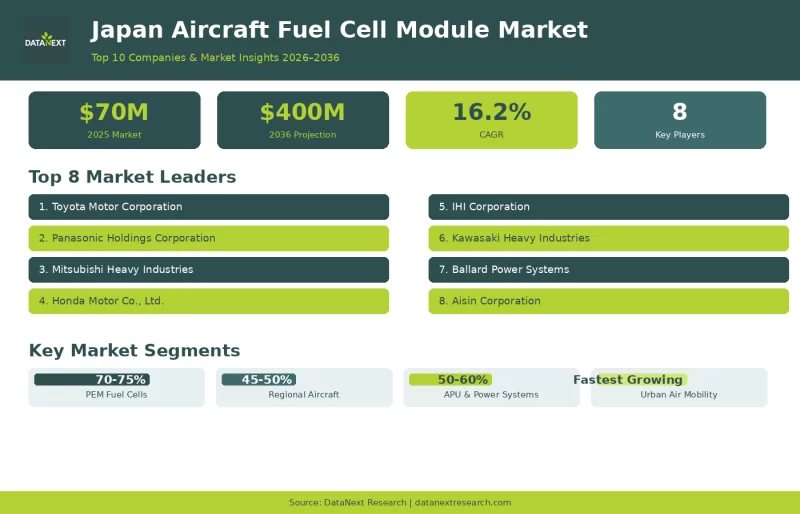
Aviation remains among the most challenging sectors to decarbonize, owing to stringent safety requirements, high energy-density demands, and long asset lifecycles. Japan is actively addressing this transition through sustained investments in hydrogen-based propulsion technologies aligned with its broader national hydrogen strategy. The Japan aircraft fuel cell module market is valued at approximately USD 70 million in 2025 and projected to reach nearly USD 400 million by 2036, at a CAGR of 16.2%. This growth reflects the country’s strategic commitment to advancing hydrogen as a viable aviation energy carrier and positions its aerospace ecosystem at the forefront of next-generation sustainable propulsion systems.
Looking for a deeper understanding of how hydrogen fuel cell propulsion systems, cryogenic onboard storage technologies, and hybrid-electric aircraft architectures are shaping the future of zero-emission aviation in Japan?
Explore the full market analysis:
https://datanextresearch.com/report/japan-aircraft-fuel-cell-module-market
This projected growth corresponds with measurable advancements in key enabling technologies, including proton exchange membrane (PEM) fuel cells capable of operating under low-pressure, low-temperature conditions associated with high-altitude flight, lightweight cryogenic hydrogen storage solutions optimized for aerospace integration, and power management electronics designed to coordinate megawatt-scale electric propulsion architectures. These developments are being supported by Japan’s established leadership in automotive fuel cell commercialization, driven by companies such as Toyota, Honda, and Panasonic, alongside its advanced aerospace manufacturing base anchored by Mitsubishi Heavy Industries, Kawasaki Heavy Industries, and IHI Corporation.
The companies profiled in this report collectively represent the critical components of the emerging aircraft fuel cell value chain, encompassing fuel cell stack development, hydrogen storage integration, thermal management systems, and aerospace-grade power electronics. Together, they are contributing to the technological transition from hydrocarbon-based propulsion toward electrochemical energy conversion systems within Japan’s future aviation landscape.
1. Toyota Motor Corporation
Toyota Motor Corporation is a key technology contributor within Japan’s emerging aircraft fuel cell module ecosystem, drawing on more than two decades of experience in proton exchange membrane (PEM) fuel cell system development through its hydrogen-powered mobility platforms. Headquartered in Toyota City, Japan, the company reported consolidated revenues of approximately JPY 45.1 trillion (USD ~300 billion) in FY2024 and employs over 375,000 personnel globally across an extensive manufacturing and R&D network.
The established expertise of the company in PEM fuel cell stack architecture, hydrogen storage integration, and automotive-grade power electronics, commercialized through platforms such as the MIRAI fuel cell vehicle, provides a technological foundation for potential adaptation within aerospace auxiliary and propulsion power systems. Ongoing internal R&D initiatives are focused on evaluating fuel cell system performance under aviation-relevant operating environments, including low-pressure, low-temperature conditions associated with high-altitude flight.
These exploratory efforts include assessment of system-level thermal management, air supply optimization, and structural integration considerations necessary to meet aerospace performance and reliability thresholds. Such adaptations are essential for achieving the power density, operational durability, and redundancy requirements associated with electrically driven aircraft architectures.
2. Panasonic Holdings Corporation
Panasonic Holdings Corporation serves as an enabling technology provider within Japan’s aircraft fuel cell module value chain, particularly in the areas of hydrogen storage and onboard power management systems. Headquartered in Osaka, Japan, Panasonic reported consolidated revenues of approximately JPY 8.5 trillion (USD ~57 billion) in FY2024 and employs over 230,000 personnel globally.
The company’s experience in stationary fuel cell systems, including residential hydrogen-based cogeneration platforms, supports the development of high-pressure hydrogen storage technologies and associated energy management electronics applicable to aviation environments. Panasonic’s composite pressure vessel technologies and carbon fiber reinforcement systems are being evaluated for potential deployment in mobility applications requiring weight-optimized hydrogen storage.
In parallel, Panasonic’s power electronics capabilities, developed through hybrid vehicle systems and grid-scale energy storage platforms, may support the integration of fuel cell modules within hybrid-electric propulsion architectures. These systems enable DC-DC conversion, load balancing between energy sources, and thermal regulation across onboard electrical networks in accordance with safety-critical operational requirements.
3. Mitsubishi Heavy Industries, Ltd. (MHI)
Mitsubishi Heavy Industries, Ltd. (MHI) is a central systems integrator within Japan’s hydrogen aviation technology landscape, leveraging its aerospace engineering capabilities and advanced manufacturing infrastructure. Headquartered in Tokyo, Japan, MHI reported consolidated revenues of approximately JPY 4.7 trillion (USD ~31 billion) in FY2024 and employs over 80,000 personnel globally.
The company is engaged in evaluating next-generation propulsion architectures incorporating hydrogen-based energy systems for potential use in regional and short-haul aircraft platforms. These initiatives include feasibility assessments of proton exchange membrane (PEM) fuel cell modules integrated with high-voltage electrical distribution systems, cryogenic hydrogen storage solutions, and advanced thermal management frameworks.
Such system-level integration studies address engineering considerations including onboard hydrogen storage configuration, fuel cell waste heat dissipation, electrical system redundancy, and impacts on aircraft center-of-gravity and structural load distribution. MHI’s aerospace portfolio and regulatory engagement experience support ongoing exploration of certification pathways associated with hydrogen-electric aviation technologies.
4. Honda Motor Co., Ltd.
Honda Motor Co., Ltd. contributes to Japan’s aircraft fuel cell module ecosystem through its established PEM fuel cell system expertise developed across hydrogen mobility platforms such as the FCX Clarity and subsequent fuel cell electric vehicle programs. Headquartered in Tokyo, Japan, Honda reported consolidated revenues of approximately JPY 20.4 trillion (USD ~135 billion) in FY2024 and employs over 200,000 personnel globally.
Honda’s fuel cell R&D initiatives emphasize compact stack architecture and system-level packaging efficiency, characteristics relevant to aviation auxiliary power applications. In particular, fuel cell-based auxiliary power units (APUs) are being explored as a potential near-term entry point for hydrogen integration within aircraft electrical systems.
Such applications may enable onboard electrical power generation for environmental control, cabin systems, and ground operations without reliance on conventional combustion-based APUs. Compact fuel cell module configurations designed for integration within existing APU compartments could reduce structural modification requirements while supporting operational evaluation of hydrogen-powered onboard energy systems.
5. IHI Corporation
IHI Corporation contributes propulsion engineering and cryogenic systems expertise to Japan aircraft fuel cell module ecosystem, particularly in hydrogen fuel delivery and thermal management technologies. Headquartered in Tokyo, Japan, IHI reported consolidated revenues of approximately JPY 1.5 trillion (USD ~10 billion) in FY2024 and employs over 28,000 personnel globally.
The company’s experience in jet engine development and rocket propulsion systems supports ongoing R&D related to cryogenic hydrogen transfer and conditioning for aviation environments. These initiatives include development of vacuum-insulated transfer lines, cryogenic valve assemblies, and integrated thermal management systems designed to maintain operational stability during dynamic flight conditions.
IHI is also participating in hydrogen propulsion feasibility initiatives within Japan’s advanced air mobility ecosystem, including evaluation of fuel cell systems for electric vertical takeoff and landing (eVTOL) platforms. Such short-range operating profiles are being assessed for potential compatibility with hydrogen-based energy systems requiring rapid refueling and higher gravimetric energy density relative to battery-electric alternatives.
6. Kawasaki Heavy Industries, Ltd. (KHI)
Kawasaki Heavy Industries, Ltd. (KHI) is a strategically integrated company within Japan hydrogen aviation development landscape, supported by capabilities spanning hydrogen production, liquefaction, transport, storage, and end-use system engineering. Headquartered in Kobe, Japan, KHI reported consolidated revenues of approximately JPY 1.9 trillion (USD ~12.5 billion) in FY2024 and employs over 39,000 personnel globally.
Within aviation-focused hydrogen initiatives, Kawasaki is pursuing internal R&D related to proton exchange membrane (PEM) fuel cell propulsion architectures for potential integration into regional aircraft platforms. These development programs include evaluation of cryogenic hydrogen storage technologies, fuel delivery and conditioning systems, onboard electrical distribution modules, and thermal management frameworks.
Kawasaki’s engineering approach emphasizes system-level integration across propulsion subsystems to assess performance trade-offs associated with hydrogen storage mass, electrical load distribution, and operational safety requirements under flight conditions. The company continues to advance hydrogen-powered aviation concepts through collaboration with domestic stakeholders across Japan’s aerospace and energy sectors, aligned with long-term zero-emission aviation objectives.
7. Ballard Power Systems
Ballard Power Systems Inc., a Canada-based developer of proton exchange membrane (PEM) fuel cell technologies, participates in the global hydrogen aviation ecosystem through the development of high-performance fuel cell stacks designed for mobility and stationary applications. Headquartered in Burnaby, British Columbia, Ballard reported revenues of approximately USD 102 million in FY2024 and employs over 1,000 personnel globally across engineering, manufacturing, and system integration functions.
The company’s PEM fuel cell stack platforms, originally developed for automotive, rail, marine, and heavy-duty mobility applications, are being evaluated for potential adaptation within aerospace auxiliary power and propulsion systems. These stack technologies are designed to deliver high operational durability, low-temperature start capability, and scalable modular architecture, characteristics considered relevant for integration into electrically driven aviation platforms under development.
Ballard’s experience in supplying fuel cell stacks to third-party system integrators supports a modular deployment model in which propulsion or auxiliary power modules are customized to meet application-specific performance and certification requirements. This approach enables aerospace developers to incorporate commercially validated fuel cell technologies within experimental or demonstration-stage hydrogen-electric aircraft programs while retaining system-level integration responsibilities.
8. Aisin Corporation
Aisin Corporation contributes specialized balance-of-plant components relevant to fuel cell system integration within Japan’s emerging aircraft fuel cell module ecosystem. Headquartered in Kariya, Japan, Aisin reported consolidated revenues of approximately JPY 4.5 trillion (USD ~30 billion) in FY2024 and employs over 110,000 personnel globally across automotive components, energy systems, and advanced mobility technologies.
The experience of the company in developing fuel cell-related subsystems, including air compressors, hydrogen recirculation pumps, and thermal management modules, supports potential application in hydrogen-based propulsion architectures requiring compact, high-efficiency system integration. These components are critical to maintaining fuel cell module performance, operational durability, and system-level stability across mobility platforms.
Aisin’s centrifugal air compressor technologies for fuel cell cathode air supply are engineered to deliver elevated pressure ratios within compact packaging envelopes, characteristics that may be relevant in evaluating fuel cell system performance under reduced ambient pressure environments associated with high-altitude operation. Additionally, the company’s oil-free bearing technologies and high-speed motor drive systems support vibration-resistant operation in dynamic mobility environments.
Aisin’s close collaboration within Toyota Group fuel cell development initiatives provides access to advancements in automotive-scale hydrogen system technologies, enabling the company to evaluate potential adaptations of balance-of-plant components for use in aviation-relevant hydrogen-electric propulsion concepts.
Ascending Toward Zero-Emission Flight
The Japan aircraft fuel cell module market is projected to grow from USD 80 million in 2026 to nearly USD 400 million by 2036, reflecting the gradual transition of hydrogen-electric propulsion technologies from laboratory-scale validation toward early-stage demonstration and pilot deployment in aviation environments. This projected growth represents not only an expansion in addressable market opportunity but also a broader technological and industrial shift in how onboard aircraft power systems may be generated in support of long-term decarbonization objectives.
The companies profiled in this report collectively represent the complementary capabilities required to support this transition. Toyota Motor Corporation and Honda Motor Co., Ltd. contribute experience in automotive-scale PEM fuel cell system development and manufacturing. Panasonic Holdings Corporation offers enabling technologies related to hydrogen storage and onboard power management. Mitsubishi Heavy Industries, Ltd. brings aerospace systems integration and certification pathway expertise. Kawasaki Heavy Industries, Ltd. is engaged in hydrogen infrastructure and propulsion system R&D initiatives. IHI Corporation contributes propulsion engineering and cryogenic fuel handling technologies. Ballard Power Systems Inc. provides PEM fuel cell stack platforms with mobility-sector deployment experience, while Aisin Corporation supplies balance-of-plant components relevant to fuel cell system integration.
The advancement of aircraft fuel cell technologies will depend on progress across multiple parallel domains beyond stack performance alone, including certification framework development, airport-level hydrogen infrastructure readiness, lifecycle cost optimization relative to conventional jet fuel systems, and operational safety validation. Japan’s coordinated approach, supported by government-led hydrogen strategy initiatives, industrial R&D investments, and long-horizon technology development programs, positions its aerospace and energy sectors to contribute to the maturation of hydrogen-based aviation propulsion concepts over the coming decade.
As aerospace OEMs and advanced mobility developers across Japan increasingly evaluate hydrogen-based propulsion platforms to address long-term decarbonization targets, aircraft fuel cell modules are emerging as a critical enabling technology for next-generation sustainable flight systems.
Are you positioned to benefit from this transition?
Our Japan Aircraft Fuel Cell Module Market (2026–2036) report delivers:
- Technology-level outlook across PEM fuel cell propulsion architectures
- Aircraft integration and auxiliary power system deployment trends
- Hydrogen storage and thermal management technology landscape
- eVTOL and regional aircraft fuel cell adoption pathways
- Certification and infrastructure readiness assessment
- Competitive profiling of leading fuel cell system developers
Download the Sample Report Now:
https://datanextresearch.com/report/japan-aircraft-fuel-cell-module-market?action=Download+Sample
Access the Full Market Report:
https://datanextresearch.com/report/japan-aircraft-fuel-cell-module-market
Related Articles
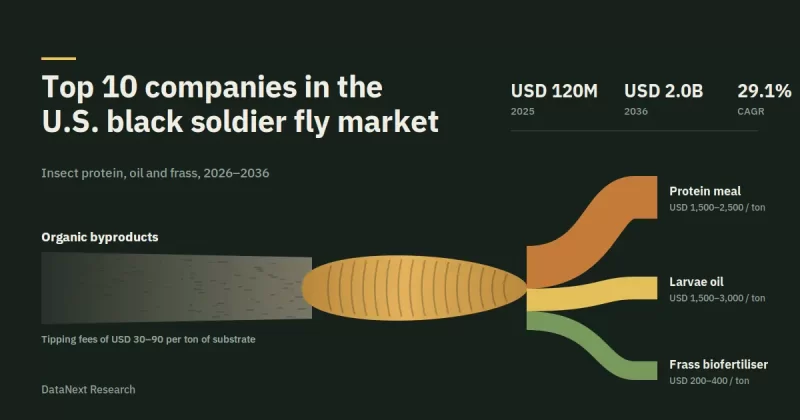
Top 10 Companies in the U.S. Black Soldier Fly Market
The top 10 U.S. black soldier fly companies in a market heading to USD 2.0 billion by 2036 — EnviroFlight, InnovaFeed, Protix, Entobel and more, ranked.

Top 10 Companies in the U.S. Modular Housing Market
Discover the top 10 U.S. modular housing companies driving growth to USD 21 billion by 2036 — Clayton Homes, Champion Homes, Cavco, Fading West and more.
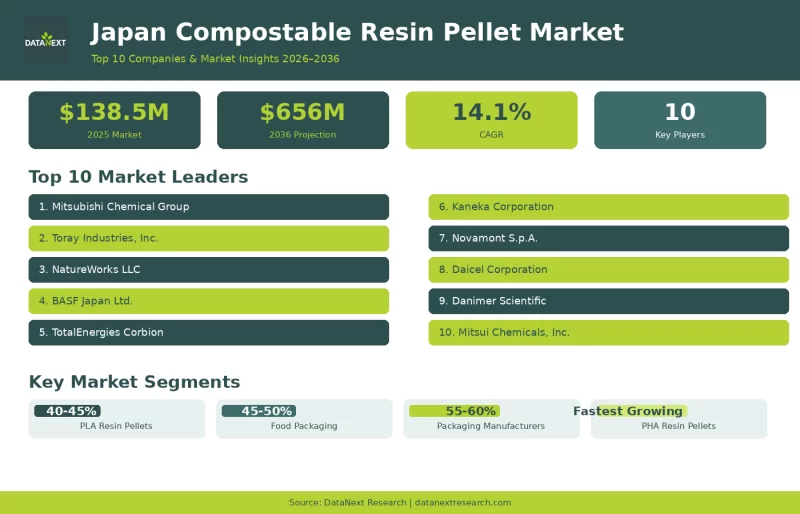
Top 10 Companies in the Japan Compostable Resin Pellet Market
Discover the Top 10 Companies in the Japan Compostable Resin Pellet Market driving growth to USD 656M by 2036, advancing PLA, PHA & bio-based packaging innovation.