
Top 10 Companies in the U.S. Black Soldier Fly Market
Top 10 Companies in the U.S. Black Soldier Fly Market
Published: September 2, 2026 · Category: Food and Agriculture · Read time: ~12 minutes
Here is the awkward thing about writing a "top companies" list for insect protein in 2026: several of the biggest names in the sector spent the last eighteen months either shutting down, pausing, or quietly moving their production plans to another continent.
That is not a reason to skip the list. It is the reason to read it carefully.
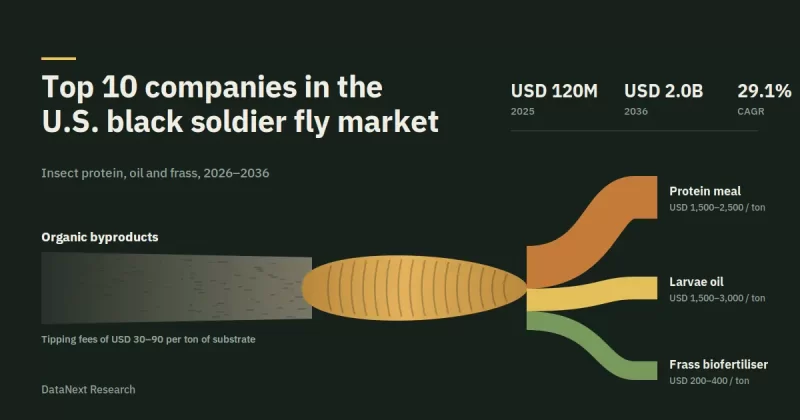
The U.S. black soldier fly market was worth USD 120 million in 2025 and is projected to reach USD 2.0 billion by 2036, growing from USD 155 million in 2026 at a CAGR of 29.1%. Those are the sharpest growth numbers you will find in agricultural inputs, and they are believable precisely because the base is so small. But the same period has produced the most brutal shakeout the insect farming industry has ever seen. France's Ÿnsect, the sector's flagship and the recipient of more than USD 600 million in funding, went into judicial liquidation in December 2025. Roughly a quarter of the twenty largest insect farming startups have failed in recent years, and the companies that shut down account for close to half of all money ever invested in the industry.
So the sector is simultaneously the fastest-growing feed ingredient category in America and the one with the highest body count. Both things are true, and understanding why is the whole point.
The economics, plainly stated. A black soldier fly larva eats low-value organic material and turns it into three sellable products at once: a protein meal running 40–60% crude protein, an oil with a fat profile comparable to coconut oil, and frass, a nitrogen-rich residue that works as an organic biofertiliser. Producers can also charge a gate fee for taking the waste in the first place — typically USD 30–90 per metric ton of substrate. Stack all four revenue lines and the model works. Rely on protein alone and it does not, because insect meal has historically cost several times more than fishmeal and roughly an order of magnitude more than soybean meal.
That single sentence explains almost every success and every failure in this list.
What makes the U.S. different. Regulation here has been unusually cooperative. Black soldier fly larvae hold AAFCO ingredient definitions covering poultry, swine, select aquaculture species and pet food, and the FDA has advanced the amendment of the dried BSF larvae definition to include poultry feeding. Compare that with the EU, where rules block insect farms from using post-consumer food waste and most animal by-products — the cheap feedstocks that make the numbers work. American producers also sit next to enormous, low-cost streams of pre-consumer agricultural by-product. Whether they can convert that structural advantage into cost-competitive protein is the open question of the next decade.
Want the full analysis — pricing by product form, volume forecasts, capacity, and competitive benchmarking? Explore the complete report: U.S. Black Soldier Fly Market (2026–2036)
The 10 companies at a glance
| # | Company | Base | Position in the U.S. market | Status signal |
|---|---|---|---|---|
| 1 | EnviroFlight (Darling Ingredients) | Maysville, KY | First purpose-built U.S. BSF facility | Up to 3,200 t/yr dried larvae |
| 2 | InnovaFeed (with ADM) | France / Decatur, IL | Largest planned U.S. capacity | Pilot paused; project still active |
| 3 | Protix (with Tyson Foods) | Netherlands | Planned Nebraska mega-facility | On hold; pivoting to Southeast Asia |
| 4 | Sentara Group (ex-Nutrition Technologies) | Johor, Malaysia | Export supplier to U.S. and EU | GMP/HACCP certified; rebranded 2025 |
| 5 | Entobel | Vietnam | Low-cost meal, oil and frass | 300–400 t meal per month |
| 6 | Entosystem | Quebec, Canada | Retail treats, pet food, aquafeed | CAD 58M raised; scouting a U.S. site |
| 7 | EVO Conversion Systems | College Station, TX | Eggs, neonates and production tech | Texas A&M spin-out |
| 8 | Symton BSF | College Station, TX | Live and dried larvae for pet retail | Serves reptile, bird and zoo channels |
| 9 | Chapul Farms | McMinnville, OR | Phased commercial plant, frass focus | Downsized from a North Dakota plan |
| 10 | Oberland Agriscience | Halifax, Canada | Protein and frass, poultry-led | Shipping commercial volumes |
1. EnviroFlight (a Darling Ingredients company)
EnviroFlight is the closest thing the United States has to an established, industrial black soldier fly producer, and its position comes from patient corporate ownership rather than venture capital.
The company opened the first commercial BSF facility in the U.S. in Maysville, Kentucky in late 2018, starting at 900 tons of dried larvae a year. In December 2020 it committed USD 20 million to expand the site, adding more than 173,000 square feet to the original 112,500-square-foot plant. Capacity now runs to roughly 3,200 tons of dried larvae per year, and the products go into animal feed and pet food as specialty proteins and oils.
The structural advantage here is the parent. Darling Ingredients generated USD 6.1 billion in revenue in fiscal 2025, and EnviroFlight sits inside its Feed Ingredients segment alongside the Nature Safe organic fertiliser business. Darling has spent more than 140 years building a business out of turning by-products into ingredients, which means insect protein is not a moonshot for them — it is an adjacent product line with an existing sales channel into feed and pet food buyers. In a sector where the primary cause of death has been running out of money mid-scale-up, having a profitable industrial parent is not a footnote. It is the strategy.
2. InnovaFeed (in partnership with ADM)
InnovaFeed has the most ambitious American plan in the industry, and the most complicated recent history.
The French company opened its North American Insect Innovation Center in Decatur, Illinois in April 2024 — a 100,000-square-foot pilot plant with about ten staff, sited next to ADM's corn processing complex so it could feed larvae on corn by-products delivered by pipeline. The full-scale facility planned alongside it would have been the largest insect protein site in the world: up to 300,000 tons of by-product a year converted into 60,000 tons of protein, 20,000 tons of oil, and 400,000 tons of fertiliser.
Then, roughly eighteen months after opening, InnovaFeed suspended operations at the pilot and paused its U.S. activities. Expected grant funding had not materialised.
The story does not end there, and reporting it as a simple failure would be wrong. The company says the industrial project remains aligned with its long-term roadmap and that its U.S. plans are still live, citing promising results from eighteen months of piloting corn co-products as a rearing substrate. In April 2026 it secured an USD 11.8 million USDA grantunder the Fertilizer Production Expansion Program to support frass-based fertiliser production at the site. Its French facility at Nesle is targeting profitability by the end of 2027, and it has signed aquaculture partnerships with BioMar, Auchan and NaturAlleva. ADM remains its exclusive pet food distributor for the U.S., Canada and Mexico, selling under the Hilucia brand.
InnovaFeed is the clearest test case in the sector: can a company with a blue-chip agribusiness partner, a co-located feedstock pipeline and federal support actually make American insect protein pay?
3. Protix (in partnership with Tyson Foods)
Protix is the world's second-largest insect farming company and, for a while, looked like the one that would crack the American market.
In late 2023 Tyson Foods — the largest meat company in the United States — invested in the Dutch producer, and the two announced plans for a large facility near Tyson's cattle operation in Dakota City, Nebraska. The design called for roughly 70,000 tons of larvae a year, fed on cattle paunch from the adjacent slaughterhouse. Design and technical work was completed.
The project is now on hold indefinitely.
Protix has instead pivoted toward Southeast Asia, where feedstock rules are looser, labour, land and energy cost less, and warm climates cut the enormous energy bill for climate control. Black soldier flies want to be kept at around 28°C, which is cheap in Malaysia and expensive in the Netherlands. Its Dutch facility is being repositioned as a technology and development hub rather than a long-term production site, and a planned Polish plant has been shelved.
Protix leadership has pushed back firmly on the idea that Ÿnsect's collapse says anything about black soldier flies, pointing out that mealworms and BSF are entirely different businesses. That is a fair correction. But the Nebraska pause is still the single most consequential development in the U.S. market over the past two years, and any forecast should account for it.
4. Sentara Group (formerly Nutrition Technologies)
If you are searching for Nutrition Technologies, you are looking for Sentara Group. The Singapore-founded, Malaysia-operating producer rebranded in 2025 alongside a leadership strengthening and ownership changes.
The company matters to the U.S. market as an importer rather than a domestic producer. It makes insect meal and whole dried black soldier fly larvae at a GMP- and HACCP-certified facility in Johor Bahru, with full regulatory approval to export to both the European Union and the United States. It also runs a separate Control Union-certified biofertiliser plant producing frass-based bioactive fertilisers and biostimulants developed to suppress tropical fungal plant diseases, cleared for organic use in Japan, the EU, Australia, Canada and the U.S.
This is the shape of the import side of the U.S. market. A meaningful share of the whole dried larvae sold into American retail — backyard poultry treats, reptile feed — comes from Asian producers whose cost base domestic producers cannot yet match. Sentara has raised capital from investors including Thai energy group PTT, whose robotics arm has worked with it on production automation.
5. Entobel
Entobel is the quiet cost-leadership story, and the one U.S. buyers should probably be watching most closely on price.
The Vietnam-based producer has operated at commercial scale since 2019 and hit a rough commissioning period when it brought a new southern Vietnam factory online in early 2024 — its founders have been unusually candid that, like most of their peers, they underestimated how hard scaling insect production would be. Those issues were largely resolved by the end of 2024, and the company now routinely produces 300 to 400 tons of insect meal a month alongside oil and frass.
Since stabilising, it has aimed squarely at becoming the global cost leader, and reported hitting a production cost milestone in December 2025 that it says makes broader feed applications viable. The logic is geographic: it is rearing a tropical insect in the tropics, with in-house technology designed around local weather rather than fighting it, which keeps both capital intensity and energy use low. In 2024 it opened a research facility in Sumatra to test palm oil waste streams as feedstock.
For American aquafeed formulators, Entobel represents the price benchmark that domestic protein has to approach.
6. Entosystem
Entosystem is the North American producer with the clearest read on why the sector struggled, and it comes down to feedstock.
The Quebec company's position is that viable insect production has to be built on residual streams that currently have little or no value — material that costs someone money to dispose of. Its Drummondville facility runs on pre-consumer food waste that would otherwise reach landfill, which is both traceable and cheap. Management frames the industry's recent troubles as problems of execution complexity, capital intensity, and poorly chosen feedstock strategies rather than weak fundamentals.
Following a CAD 58 million (about USD 42 million) raise in 2024, the company has scaled Drummondville and is evaluating a second site in the United States.
Its route to market is also instructive. Rather than chasing commodity aquafeed first, Entosystem built a strong position in premium backyard chicken treats, where a white-label offering is gaining traction with large retail chains. Pet food in the U.S. is building momentum, and North American aquaculture interest is accelerating — driven partly by the finding that even low inclusion rates of BSF improve animal health, which lets formulators adopt it without rewriting recipes. The company has funded multi-year studies on frass as a biostimulant and argues the industry still undervalues it.
7. EVO Conversion Systems
EVO is not a protein producer, which is exactly why it belongs on this list.
Spun out of Texas A&M University by entomology professor Jeff Tomberlin, the College Station company supplies the inputs and the know-how that other producers need: fertilised eggs, colony development, consulting, and the equipment that surrounds BSF rearing — breeding cages, egg traps, rack systems, dryers, sifters. It also developed a patented device that holds larvae in a juvenile state for an extended period, licensed to other producers, with the aim of making output predictable rather than experimental.
There is a broader lesson here. A recurring diagnosis of the sector's failures is that first-generation companies tried to build vertically integrated mega-factories from scratch, inventing every part of the process themselves. The emerging alternative is a supply chain — specialist providers of genetics, neonates, equipment and process knowledge — that lets a new entrant start from a known baseline. EVO has been building that layer, along with a consortium model, for years.
8. Symton BSF
Symton occupies the least glamorous and most consistently profitable corner of the market: selling larvae to people who own reptiles and chickens.
Based in College Station, Texas and sharing a building with EVO in a separate but symbiotic arrangement, Symton grows out larvae and distributes them as feeder-grade product in small, medium and large sizes, along with canned larvae, pupae, pre-pupae, eggs and frass. Its customers are the reptile and exotic pet trade, breeders, zoos and the backyard poultry market.
This segment is worth understanding properly because it distorts a lot of market commentary. Retail whole dried larvae command far higher prices per ton than feed-grade meal, which means a modest volume business here can be healthier than a much larger commodity operation. It is also the segment most exposed to low-cost Asian imports. The producers who survive in it do so on freshness, service and channel relationships rather than price.
9. Chapul Farms
Chapul is the case study in scaling down deliberately, which in this sector counts as sophistication.
Founder Pat Crowley originally planned a large black soldier fly plant next to a corn ethanol facility in North Dakota. That project required a big capital stack and stalled when the company could not land a lead equity partner. Rather than push on, Chapul redirected to a smaller commercial facility in McMinnville, Oregon — a converted plastics plant, closer to the team, built in phases so each stage can be financed and de-risked separately. It will run on a blend of landfill-diverted food waste and dry bakery waste, the latter used to tune moisture levels.
Crowley's read on the industry's setbacks is worth taking seriously: not one flaw, but over-ambitious business models, poorly matched capital, and in several cases too much money spent on automation. His framing is that insect agriculture has three pillars — waste management, protein and fat production, and frass — and that models optimised for only one of them, as many European protein-factory builds were, end up fragile. Chapul has put substantial resources into developing frass markets specifically.
10. Oberland Agriscience
The Halifax, Nova Scotia company has moved into commercial shipping of both protein and frass, and appointed food industry veteran Jon Getzinger as CEO as it entered its next phase.
Founder Greg Wanger makes the argument that will probably decide whether BSF protein becomes a commodity or stays a specialty: on price alone, competing with soy is very hard. But BSF confers anti-inflammatory and anti-microbial benefits and improved growth performance, and once you ask an aquaculture operator what reduced mortality or avoided antibiotics is worth to them, the conversation stops being about price per ton. The data to support that case is only now arriving.
Oberland feeds its larvae spent brewers' grains and fruit and vegetable waste from large processors, and recaptures heat generated in one part of the facility to warm the rest — a neat solution in Halifax, and a reminder that plant design has to be climate-specific. Poultry is currently its fastest-growing protein market, with pet food and aquaculture conversations underway.
Also worth watching
- Hexafly (Ireland) and Jord Producers (U.S.) — both named among producers serving or supplying this market.
- FreezeM (Israel) — sells black soldier fly neonates as a service, effectively acting as the seed company for the industry, with around 40 customers at various stages.
- nextProtein (France/Tunisia) — raised EUR 18 million in late 2025; second site targeted for Q4 2026 at 2,500 tons of protein meal a year, built on the thesis that European-only production cannot work.
- Volare (Finland) — building a 5,000-ton dry protein meal facility at a brownfield site in Pori, with an offtake agreement with aquafeed giant Skretting.
- Protenga (Malaysia/Singapore) — a modular, capital-light model that places farms next to feedstock and buys the larvae back; reports operating profitability.
And two important absences. Ÿnsect entered judicial liquidation in December 2025. Aspire Food Group's Ontario cricket facility went into receivership and its assets were sold. Neither farmed black soldier flies — Ÿnsect was mealworms, Aspire crickets — but both shaped how investors now price the entire category.
Who is actually buying
A "top companies" list is only half the picture in a market this young. The demand side tells you more.
In aquafeed, the buyers are major feed companies including Skretting and Cargill, plus aquaculture producers substituting BSF meal for fishmeal. The report puts fishmeal replacement at up to 50% in aquaculture feed applications; some producers claim higher substitution rates commercially.
In pet food, insect-focused brands such as Jiminy's and Chippin sit alongside mainstream buyers including Nestlé Purina and Mars Petcare. This is where the value is. Pet food premiumisation, novel-protein positioning and hypoallergenic claims support prices that commodity feed never will.
In animal feed, poultry and swine integrators and feed mills are the addressable buyers, and their volume grows directly with each regulatory approval.
And the strategic layer sits above all of it: Darling Ingredients, ADM, Tyson Foods and Cargill are partners and investors, not just customers. Their continued participation is the single best leading indicator for this market. Their hesitation is the single best warning sign.
Frequently asked questions
What is the U.S. black soldier fly market worth? The market was valued at USD 120 million in 2025 and is projected to reach USD 2.0 billion by 2036, growing from USD 155 million in 2026 at a 29.1% CAGR. The figure covers protein meal, whole dried larvae, larvae oil and frass biofertiliser across aquafeed, animal feed, pet food and agriculture.
Who are the largest black soldier fly companies in the United States? EnviroFlight, a Darling Ingredients company, operates the first purpose-built U.S. BSF facility in Maysville, Kentucky, with capacity of up to 3,200 tons of dried larvae a year. InnovaFeed, partnered with ADM, holds the largest planned U.S. capacity in Decatur, Illinois, though its pilot operations are currently paused. Smaller domestic specialists include EVO Conversion Systems, Symton BSF and Chapul Farms.
Are black soldier fly larvae approved for animal feed in the U.S.? Yes. AAFCO ingredient definitions cover use in poultry, swine, select aquaculture species and pet food, and the FDA has advanced the amendment of the dried BSF larvae definition to include feeding to poultry. Each approval opens a new feed application, and further approvals — including for cattle — would expand the market again.
What do black soldier fly products sell for? Feed-grade protein meal runs roughly USD 1,500–2,500 per ton and larvae oil around USD 1,500–3,000 per ton, while frass biofertiliser sells for approximately USD 200–400 per ton. Whole dried larvae range from feed-grade wholesale levels to substantially higher retail prices for reptile, bird and backyard poultry treats. Producers may also earn tipping fees of USD 30–90 per metric ton of substrate accepted.
Why have so many insect protein companies failed? The core problem is cost. Insect meal has been several times more expensive than fishmeal and roughly ten times more expensive than soybean meal, so protein sales alone rarely cover the capital and energy cost of an industrial facility. Companies that survived tend to share three traits: cheap or negative-cost feedstock, disciplined phased capex rather than mega-factories, and revenue stacked across protein, oil, frass and waste-processing fees.
Is the U.S. a net importer or exporter of black soldier fly products? Both, for now. A significant share of retail whole dried larvae sold in the U.S. is imported, largely from Asia, where production costs are lower. Domestic industrial producers focused on protein meal and oil are positioned to export as capacity scales, and the U.S. is expected to shift toward net exports of higher-value ingredients over the forecast period.
How sustainable is black soldier fly production? The case is strong on the numbers. Bioconversion reduces organic waste volume substantially before disposal, diverting material from landfill and the methane it generates. BSF protein replaces fishmeal derived from wild-caught fish, easing pressure on marine stocks. Production uses a fraction of the land, water and feed of conventional livestock protein. And frass returns nutrients to the soil, closing the loop between waste, feed and agriculture.
What happens next
The honest forecast for U.S. black soldier fly is not a straight line. It is a small market that grows quickly, punctuated by individual project failures that look alarming out of context.
Three things would change the trajectory materially. First, cost parity: the moment feed-grade meal lands consistently near fishmeal pricing, the volume market opens and the growth curve steepens. Second, regulatory expansion: an AAFCO pathway for cattle would enlarge the addressable market more than any single facility could. Third, the frass revaluation: several serious operators now argue that biofertiliser is chronically underpriced relative to its agronomic value, and if that repricing happens, it changes the economics of every plant already built.
The pattern that seems to be winning looks less like the first generation's fully automated mega-factory and more like this: modest, phased facilities sited next to genuinely low-cost feedstock, four revenue streams instead of one, and a corporate parent or offtake partner who can wait. Not glamorous. But this is agriculture, and agriculture rewards patience over ambition more often than the reverse.
The insights above draw on our full assessment of the U.S. black soldier fly market, covering:
- Market sizing and forecasts to 2036, by product and by application
- Pricing analysis by product form, including tipping and gate fees
- Volume, price and value forecasts across protein meal, oil, whole larvae and frass
- U.S. production capacity, consumption and supply-demand balance
- Export overview and import dependence for retail-grade larvae
- Competitive benchmarking across 60+ companies
Access the full report: U.S. Black Soldier Fly Market (2026–2036)
Or download a sample to review the methodology and coverage: Download Sample
Related topics: U.S. Black Soldier Fly Market · Insect Protein · BSFL · Sustainable Animal Feed · Aquafeed · Fishmeal Replacement · Frass Fertiliser · Circular Bioeconomy
Related Articles
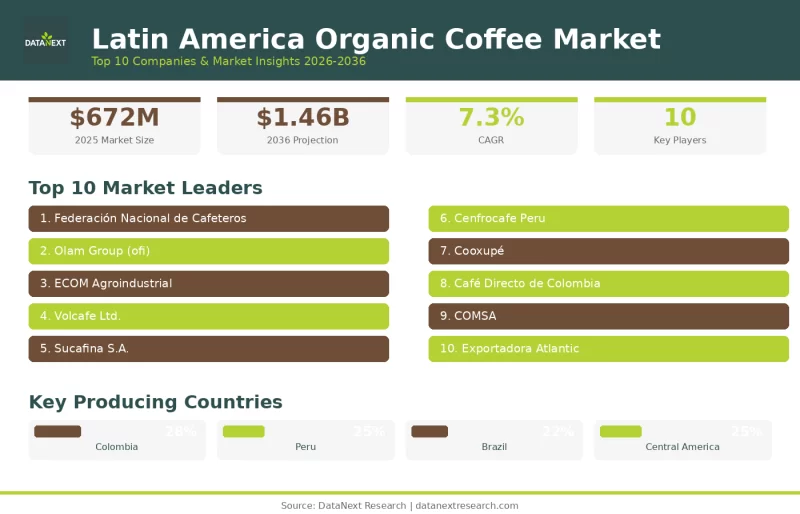
Top 10 Companies in the Latin America Organic Coffee Market
Discover the top 10 organizations driving Latin America’s organic coffee market (2026–2036). Explore leaders like FNC, Olam, ECOM, and Cooxupé shaping sustainable, traceable, and premium Arabica supply.
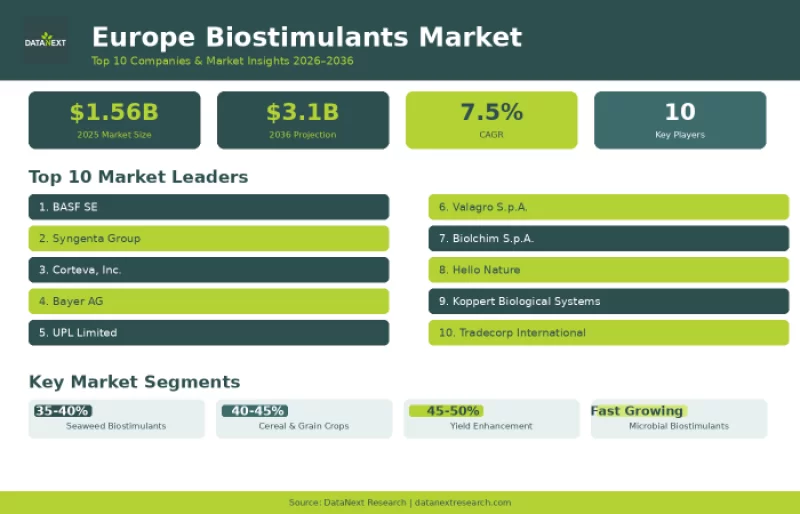
Top 10 Companies in the Europe Biostimulants Market
Discover the Top 10 Companies in the Europe Biostimulants Market driving growth to USD 3.1B by 2036. Explore leaders like BASF, Syngenta, Corteva, and more shaping sustainable crop inputs, plant growth, and stress resilience across European agriculture.
Best Food Processing Companies in Europe (Top 10) | Market Leaders & Innovation
Explore the top 10 food processing companies in Europe driving innovation, sustainability, and market growth across dairy, snacks, nutrition, and ingredients.